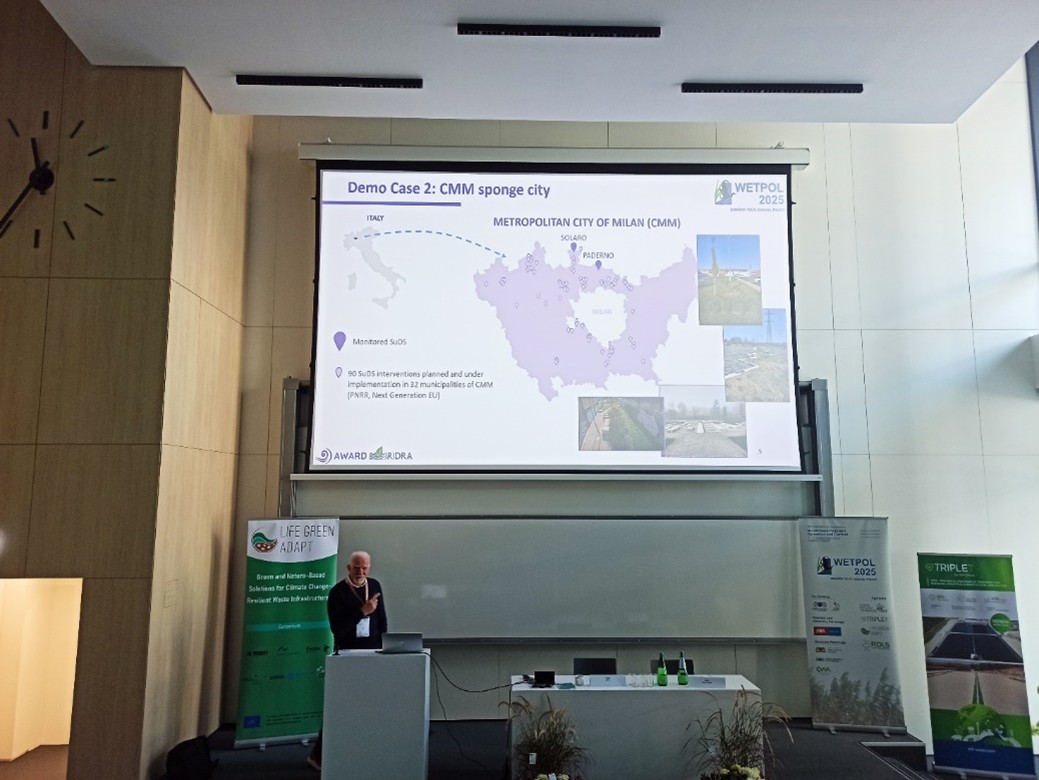
The European AWARD project was presented by Fabio Masi at WETPOL 2025, a biennial event where scientists from around the globe gather to discuss strategies for protecting and restoring natural wetlands and exploring how nature-based solutions can support effective water management.
The main pillars of the AWARD project were presented, with a specific focus on Demo Case 2, which concerns the Metropolitan City of Milan. The Metropolitan Sponge City of Milan project includes the implementation of 90 Sustainable Urban Drainage System (SuDS) interventions across 32 municipalities, funded through the PNRR (Next Generation EU) program.
In particular, the presentation focuses on the Demo Case in Solaro (Milan) where stormwater is directed either into a conventional drainage system or into a bioretention system. Both systems are connected to infiltration shafts, which include overflow mechanisms linked to the existing sewer network. Within the bioretention area, six soil moisture sensors were installed at various depths (from 5 cm down to 55 cm, at 10 cm intervals) and the readings were logged at 10-minute intervals for at least 2 years. Additionally, precipitation data were provided by rain gauges installed near the site. The goal of the study is to correlate the soil moisture data from the bioretention system with rainfall events, to identify the precipitation thresholds that activate the SuDS system and to quantify the volume of water infiltrated through the bioretention cells and the infiltration shafts.
The results show a consistent response of the soil moisture sensors to rainfall events. Almost every rainfall event caused an increase in soil moisture at multiple depths. The high sampling frequency enabled the observation of a top-down infiltration pattern for low to moderate rainfall events (return period lower than 2 years), while during more intense events (return period greater than 10 years), moisture increased from the bottom upwards, suggesting that the shafts infiltration capacity was exceeded by the volume of incoming water. Thus, the installed sensors could be considered as an appropriate monitoring solution for assessing the functionality of a bioretention area inside a complex drainage system.
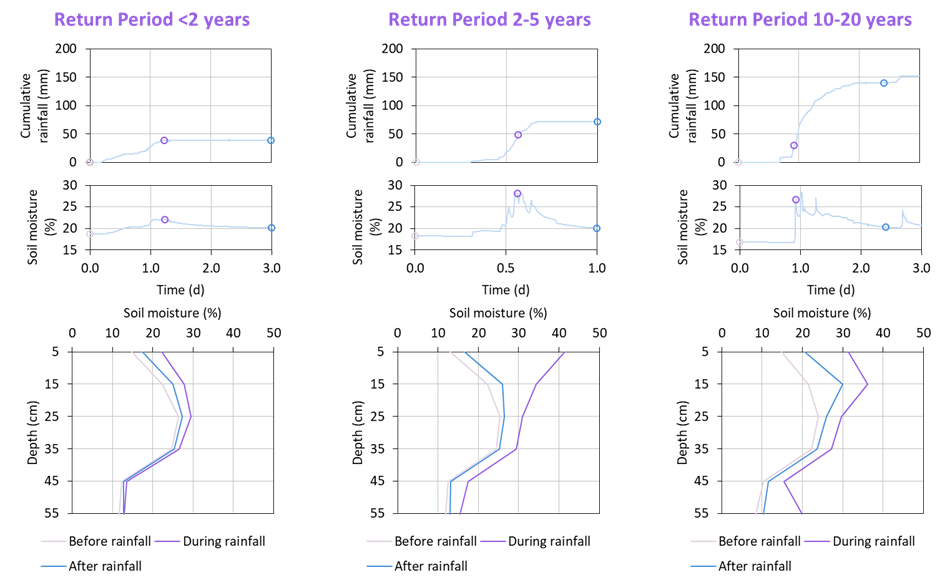
Figure 1 – Rainfall water dynamic inside the bioretention area for three different return periods.
The final objective will focus on assessing the feasibility of using soil moisture sensors within SuDS as low-cost tools for integrated water management services. This would facilitate both the evaluation of system performance, quantifying the stormwater volumes infiltrated and so diverted from the sewer network, and the operation and maintenance, permitting to set alert for controlling SuDS functioning and eventually emergency irrigation during drought periods.